Standard tummy tuck plans on this page typically range from 2,800–5,000 EUR. More extensive fleur-de-lis, circumferential or body-lift plans are quoted individually and may fall outside this range.
Written by Just Clinic Istanbul teamPublished on 31 Aug. 2026Medically reviewed on 31 Aug. 202615 min read
2,800 – 5,000 EUR
Tummy tuck cost in Turkey
As of September 2026, the tummy tuck Turkey price on this page is 2,800–5,000 EUR. A mini is not priced like a full one. Treat advertised “from” figures with caution; you pay the written breakdown.
Each month, Just Clinic Istanbul collects current prices / costs for tummy tuck procedures from 30 hospitals randomly selected from our partner network, listed on our Hospitals page. We compare equivalent treatment plans and publish the lowest and highest reported prices as a minimum–maximum range. They are a neutral, objective reference, not the price of a single hospital or clinic and not a personal offer from Just Clinic Istanbul.
The usual question is how much a tummy tuck costs in Turkey. The answer is the written quote. Some listings still show a lower tummy tuck Turkey cost; those ads of 1,500–2,250 EUR often cover theatre only, or a mini without hotel or transfers. Just Clinic Istanbul does not cut its range to match the cheapest advert. A typical tummy tuck price in Turkey in our band is a guide. The amount you pay is set after the assessment.
Abdominoplasty is the medical term for a tummy tuck. Pricing varies according to whether the surgical plan is mini, full, lipoabdominoplasty, extended or a more extensive technique.
Tummy tuck cost compared by country
Type
Turkey
UK
USA
Thailand
Mini tummy tuck
2,800 – 3,800
4,500 – 6,500
6,500 – 11,000
2,500 – 4,500
Full tummy tuck
3,200 – 4,800
5,500 – 9,000
8,000 – 16,000
3,000 – 6,000
Lipoabdominoplasty
4,000 – 5,000
6,500 – 10,000
10,000 – 18,000
4,000 – 7,000
Extended tummy tuck
From 5,000 (according to the plan)
8,000 – 14,000
Often 12,000 – 22,000
Varies by hospital
Fleur-de-lis or circumferential / body-lift plan
Quoted individually; may fall outside this page’s guide range
Varies by scope
Varies by scope
Varies by hospital
For a country-to-country comparison to mean anything, you have to match the same operation, the same hotel nights and who pays the flights. A private tummy tuck price in the UK is typically quoted in pounds for surgery alone; hotel nights are not built in because you are already at home. Use the written breakdown rather than an advertised “from” price.
A tummy tuck — abdominoplasty in medical language — removes loose skin from the abdomen that diet and exercise will not take away. The extra fold is usually left after pregnancy or a large weight change. If the two vertical muscles in the midline have drifted apart, the surgeon can stitch that gap, a diastasis, in the same operation. Liposuction on its own does not remove that apron of skin, and the procedure is not a method for losing weight.
Just Clinic Istanbul does not organise travel or accommodation. If you consent, your enquiry may be shared with an independent healthcare provider or authorised medical tourism organisation, which can explain the proposed care and its own arrangements. The surgeon named on a written medical plan is responsible for the clinical assessment and operation. For patient-focused discussion of the first days, scar and return home, see our tummy tuck recovery and scar article.
Who is a tummy tuck for?
Surgeons usually consider people who are already close to a stable, healthy weight and still have loose skin or a muscle gap that will not tighten on its own. Typical situations include more than one pregnancy, a large weight loss, or a bulge from separated abdominal muscles that gym work has not closed. This kind of cosmetic surgery is not routinely NHS-funded.
A tummy tuck is often postponed if you still plan to lose a large amount of weight, if you hope to become pregnant again soon, or if smoking or a long-term condition makes healing less safe. Blood-thinning medicines and a higher risk of clots also need a careful look. None of this is a promise that you are suitable. That decision is made after photographs, your history and a personal medical assessment.
What the operation aims to do
The realistic aims are a flatter, firmer abdominal contour, a lower scar that can sit in the line of ordinary underwear, and — on a full tummy tuck — a navel set into the tightened skin. Stretch marks that sit on the skin being removed will go with it; marks above the navel usually stay. The result is not the same on every abdomen, and no clinic can guarantee a particular look. Weight you put back on later will change the shape you see after the initial recovery.
Techniques used
The surgeon chooses the plan from your abdomen, not from a package name. A mini tummy tuck is not the same operation as a full one, and a lipoabdominoplasty adds contouring of the waist only when that combination is considered safe.
The navel usually stays put. It does not usually address loose skin or muscle laxity above the navel.
Full: the whole abdomen
The navel is usually repositioned. If the midline has separated, suturing it is often in the same operation.
Lipoabdominoplasty
A tummy tuck plus liposuction of the waist or flanks, if the surgeon considers it safe. Liposuction in other areas without the abdomen is a separate quote.
Extended tummy tuck
The lower-abdominal incision extends towards the flanks when laxity continues beyond the front of the abdomen. This is not the same as a circumferential operation, which treats a wider 360-degree area.
What types of tummy tuck are available?
There is no single universal list because surgeons describe and combine techniques differently. These terms are useful for understanding the scope of a discussion; they do not decide which operation is suitable for an individual person.
Technique
What it is usually used to address
How it differs
Mini tummy tuck
Limited loose skin below the navel.
Usually uses a shorter lower-abdominal scar and does not reposition the navel.
Full tummy tuck
Loose skin above and below the navel, sometimes with abdominal-wall laxity.
Usually needs a longer low scar and a new opening for the navel.
Extended tummy tuck
Loose skin that continues from the abdomen into the flanks.
The horizontal scar extends farther towards the sides; it is not a 360-degree body lift.
Fleur-de-lis tummy tuck
Marked skin excess in both the vertical and horizontal directions, often after substantial weight loss.
Uses a horizontal scar plus a vertical midline scar to remove skin in two directions.
Circumferential abdominoplasty / belt lipectomy
Loose tissue around the abdomen, flanks and lower back.
A more extensive 360-degree contouring operation that may be discussed as part of a body-lift plan.
Reverse abdominoplasty
Selected excess skin mainly in the upper abdomen.
The scar is placed higher, commonly near the breast crease; it is a specialised option rather than a routine substitute for a full tuck.
Lipoabdominoplasty
Loose skin with localised abdominal or waist fat where a combined plan is clinically appropriate.
Combines abdominoplasty with selected liposuction; safety depends on tissue blood supply, the extent of surgery and individual risk.
Extended tummy tuck and circumferential abdominoplasty should not be used as interchangeable labels. The first mainly lengthens the front scar into the flanks; the second can involve the torso around its full circumference and may fall outside the standard price guide on this page.
Which tummy tuck approach may be considered?
Main concern
An approach a surgeon may discuss
Mostly loose skin below the navel
Mini tummy tuck
Loose skin above and below the navel
Full tummy tuck
Skin excess extending into the flanks
Extended tummy tuck
Large vertical and horizontal skin excess after major weight loss
Fleur-de-lis tummy tuck
Loose tissue around the front, sides and lower back
Circumferential abdominoplasty or body lift
Selected excess mainly in the upper abdomen
Reverse abdominoplasty
Loose skin plus localised fat or waist contouring needs
Lipoabdominoplasty may be considered
Only an individual medical assessment can determine suitability. Weight stability, previous scars, hernias, skin quality, nicotine exposure, medical history and the safety of combining procedures all affect the recommendation.
Tummy tuck scar comparison
Type
Typical scar pattern
Belly-button repositioning
Mini
Shorter low abdominal scar
Usually not needed
Full
Longer low abdominal scar, often hip to hip, plus a scar around the navel
Usually needed
Extended
Low scar continuing farther towards the flanks
Often needed
Fleur-de-lis
Low horizontal scar plus a vertical midline scar
Depends on the plan
Circumferential / belt lipectomy
Scar continuing around the torso
Depends on the procedure
Reverse
Upper-abdominal scar, often near the breast crease
Technique dependent
Scar position, length and maturation vary with the technique, anatomy, skin quality, wound healing and whether another procedure is combined. A lower scar is often planned to sit beneath ordinary underwear, but no online guide can promise that it will be concealed by a particular garment.
Tummy tuck vs liposuction vs body lift
Procedure
Loose skin
Localised fat
Muscle repair
Wider flanks or back
Tummy tuck
Removes abdominal excess skin
May include limited removal in a planned procedure
May be considered
Limited unless the plan is extended
Liposuction
Does not remove an apron of loose skin
Removes localised fat
No
Can treat selected zones
Lipoabdominoplasty
Removes excess skin
Combines selected liposuction
May be considered
May include waist or flanks if clinically appropriate
Body lift
Addresses wider skin excess
May include liposuction
Depends on the procedure
Can address a broader 360-degree area
Liposuction is not a substitute for skin excision when the main issue is hanging skin or substantial abdominal-wall laxity. For a separate liposuction quote and procedure overview, see our liposuction cost in Turkey guide.
How long the operation takes
Theatre time is usually 2 to 4 hours. A mini can be shorter. A full tummy tuck with muscle repair, or a plan that adds liposuction or an extended incision, can take longer. Combined operations add time. The written plan is the one that counts.
Anaesthetic
A tummy tuck is usually performed under general anaesthetic. The anaesthetic team reviews your history and explains the most appropriate plan before the day of surgery.
Hospital stay
You usually stay 1 or 2 nights in hospital. That is not the same as the total time in Istanbul. Nurses help you walk from the first day. If drains are used, removal depends on the surgeon’s protocol and the amount of fluid collected. They may be removed before discharge or during a later follow-up.
How long to stay in Istanbul
If an independent healthcare provider recommends surgery, its written plan may advise 7 to 10 nights in the city for the operation, hospital nights, dressing changes, drain or suture checks and clearance to fly. The hospital stay sits inside that period; it does not replace it. The provider, not a short-stay advert, decides whether travel is medically appropriate.
What to clarify in a written provider quote
An independent healthcare provider’s written plan may set out surgery, hospital care and accommodation around scheduled checks as one figure. Just Clinic Istanbul does not arrange those services. Before paying a deposit, ask the provider to state every inclusion, exclusion, responsible party and the planned follow-up in writing.
Pre-op assessment and agreed tests
Surgeon, team and anaesthesia fees
Theatre and 1–2 hospital nights
Compression garment and immediate medication
What affects the cost of a tummy tuck?
What to do — and not do — before surgery
What to do
If you choose to make an enquiry, provide photographs and a clear history — pregnancies, weight change and previous abdominal surgery — so the independent provider can assess the request before you book flights.
Stay as close as you can to a stable weight. Large changes after the operation alter the result.
Arrange someone to help you in the first days. You will not want to lift children or heavy bags.
Follow the hospital’s fasting instructions on the day. That list comes from the ward, not from a blog.
What not to do
Do not stop or start medicines — including blood-thinners, anti-inflammatories or supplements — on your own. The surgeon and anaesthetic team tell you what to change and when.
Do not smoke if the team has asked you to stop. Smoking reduces blood flow in the skin and raises the risk of poor healing. How long to stop is their instruction.
Do not treat a short stay as a medical plan. The treating provider should confirm when it is appropriate to travel.
Do not treat the operation as a substitute for weight loss.
Recovery
Two timelines matter, and they are not the same.
Daily life and desk work. Many people manage short walks from the first day and return to light, desk-based work in 2 to 4 weeks. You may walk slightly bent at first. Swelling, tightness and numbness in the lower tummy are common. The compression garment is worn for several weeks — often around six — as the team instructs. A more physical job usually needs longer, often four to six weeks.
Full recovery and sport. Heavy lifting, core training and strenuous sport wait longer. Most people wait about six weeks before harder exercise. Some need longer — into the second or third month — before the team clears unrestricted training. The scar keeps settling for months; the contour you see at two weeks is not the final one.
Your own pace depends on the technique, your job and how you heal. Follow the written aftercare, not a generic calendar.
Risks, safety and when to seek urgent care
All operations have risks. Recognised tummy-tuck complications include bleeding or haematoma, seroma, infection, delayed wound healing or wound separation, changes in skin sensation, scarring and anaesthetic complications. Blood clots in the legs or lungs are less common but potentially serious. Individual risk can be affected by smoking or other nicotine exposure, body weight, diabetes, previous surgery, medicines, clotting history, the extent of surgery and any combined procedure.
Supported early walking, an individual clot-risk assessment and a clear plan for wound and follow-up care matter. New one-sided leg swelling or pain, sudden shortness of breath, chest pain, fainting, rapidly increasing swelling, fever, worsening redness, wound separation or escalating pain require prompt medical assessment; emergency symptoms require local emergency services rather than a messaging app.
Ask for the operating surgeon’s full name, specialty, current professional registration and the facility where the operation would take place.
Ask the provider to identify the hospital or surgical facility, its applicable authorisation or accreditation, the anaesthesia arrangements and the emergency-transfer protocol.
Request a written plan that separates the proposed technique, any muscle repair or liposuction, expected hospital observation, follow-up, total price and exclusions.
Ask who assesses possible complications after you return home, how urgent concerns are escalated and what care is available locally.
Do not rely on a package name, a before-and-after image or a low headline figure as evidence of individual suitability or safety.
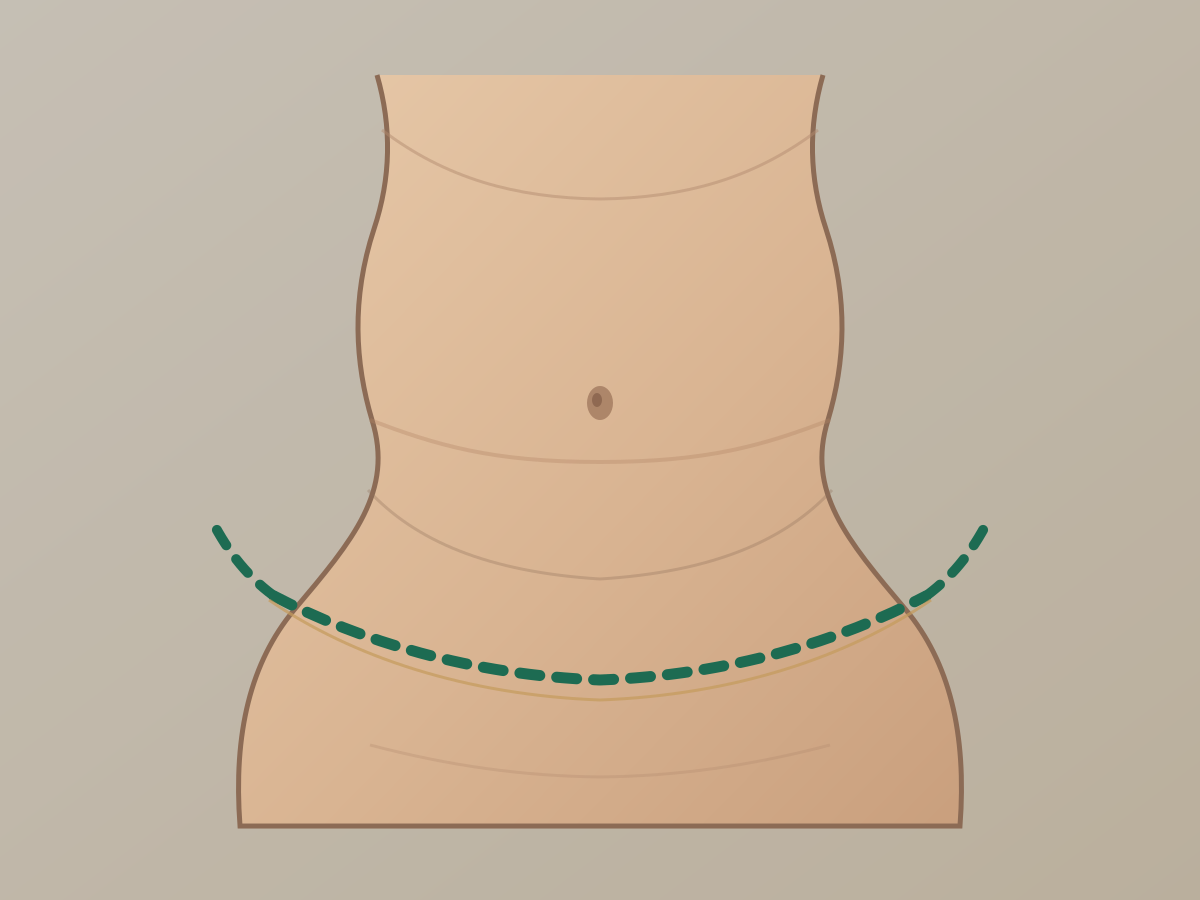
The drawings below show the skin fold and the muscle line. They are not a named patient’s photographs, and they are not a guarantee of result.
Before surgery. The surgeon decides whether the plan is mini, full or extended according to your abdomen.What the drawing shows afterwards. The scar takes months to settle; this drawing does not replace your assessment.
The photographs below are illustrative pictures of the associated surgical team in Istanbul. They are not a promise of who will operate; that name is on your written quote.
Questions from you
These notes answer questions people raise before they accept a written treatment plan. They describe what that plan should make clear. They are not a promise that any partner hospital uses a particular technique, device or payment arrangement. With your consent, an enquiry may be shared with an authorised healthcare partner.
Is the main problem extra fat, extra skin or separated abdominal muscles, and which of those will this operation treat?
ASPS notes that when a large amount of fat is removed, extra skin can need a second operation. J-Plasma, also called Renuvion, aims to tighten skin with heat. It should not be written as a replacement for a tummy tuck or an arm or thigh lift when there is a hanging skin apron or a clear separation of the abdominal muscles. Source: ASPS liposuction safety.
Which areas will liposuction include, and what personal limits will stop or stage it?
ASPS says special planning is needed when more than five litres are usually suctioned. That figure is not a safe ceiling for every person. Blood in the aspirate, the fluid given, the lidocaine dose and the length of the anaesthetic can reduce the scope or split the session. The written plan should name the areas included and the finding that would stop the operation. Source: ASPS liposuction safety.
Why combine procedures in one operation, and when should they be staged?
Several operations in one sitting should not become a package name until the time and the clot risk have been written for that person. The blood supply of an abdominal flap can be injured by aggressive waist liposuction at the same time. Walking early is part of clot prevention. A combination that stops that walking should be staged. Source: ASPS liposuction safety.
How are a seroma, a wound opening or skin loss recognised and treated?
ASPS lists fluid collection, poor wound healing and heat injury among liposuction risks. A seroma is a wavy swelling under the incision. A small one may be absorbed. A collection that persists can be aspirated. One that is infected or threatening the skin is drained. A wound that opens, or skin that turns black, is a sign of tension, smoking, infection or a circulation problem. It is not a mark to close at home with a dressing. Drains, compression and the review date should be written down. Fever, a bad smell, an open wound and rapidly growing swelling should be reported without delay. Source: ASPS liposuction safety.
After I go home, who follows a wound problem or a suspected clot, and who pays for extra treatment?
The NHS asks people having cosmetic surgery abroad to settle in advance where reviews happen and what further surgery and a return journey cost. Travel insurance usually does not cover surgical complications. The NHS uses 5–7 days after liposuction or breast surgery, and 7–10 days after a tummy tuck, as planning windows before flying. A painful swollen calf with breathlessness or chest pain is an emergency-department symptom. This page does not say that any partner pays those items. Source: NHS advice on cosmetic surgery abroad.
What happens to my existing C-section scar during a tummy tuck?
An existing caesarean scar may be included in the lower tummy-tuck incision and removed with the skin beneath it, but this cannot be promised before the surgeon examines the scar and plans the operation. The new scar is usually longer, and a full tummy tuck may also leave a scar around the navel. Previous abdominal surgery can affect the plan and result. Ask the operating surgeon to mark the proposed incision and explain in writing whether the old scar is expected to be removed, incorporated or left partly visible. ASPS explains how an existing caesarean scar may be incorporated.
Is diastasis recti always repaired during a tummy tuck?
No. A tummy tuck may include tightening or repair of separated abdominal muscles when examination shows it is part of the agreed plan, but the operation is not automatically a muscle repair for everyone. The surgeon considers the location and degree of separation, skin excess, symptoms, previous surgery and overall health. A mini procedure may address a more limited lower-abdominal area, while a full operation can address a broader area; the name of a package alone does not establish what will be done. Ask whether muscle repair is planned, which area it covers and how it changes recovery. ASPS describes abdominoplasty as potentially restoring weakened muscles.
Can muscle separation come back after a tummy tuck?
Muscle separation or abdominal-wall laxity may remain or become more noticeable after repair; repair cannot guarantee a permanently flat or fully tightened abdomen. ASPS discusses pregnancy-related muscle changes and notes that laxity may persist despite abdominoplasty with muscle repair. If you may want another pregnancy, ask the surgeon how this could affect your result and the timing of surgery. ASPS reviews abdominal muscle changes relevant to tummy-tuck results.
When can I lift my child after a tummy tuck?
Plan to arrange help with childcare because lifting is usually restricted during early healing. One NHS plastic-surgery discharge leaflet advises avoiding heavy lifting, including children, for at least six weeks after abdominoplasty, but your own surgeon may set a different restriction based on the operation and your recovery. Do not use a general timetable as personal clearance. Before surgery, ask when you may lift your child, whether the limit differs for a baby versus an older child, and who can help at home until you are cleared. Hull University Teaching Hospitals NHS guidance includes children in its lifting restriction.
Mini tummy tuck or full tummy tuck — how is that actually decided?
The choice depends mainly on where the loose skin and muscle separation are, rather than on the procedure label. A mini tummy tuck treats a more limited area below the navel; a full tummy tuck can address excess skin above and below it and may reposition the navel. The amount of liposuction, scar pattern, medical history and your goals also matter. The surgeon should explain what each option can treat in your case and what it leaves unchanged. ASPS outlines how mini and standard tummy-tuck scopes differ.
How much does a tummy tuck cost in Turkey in 2026?
+
As of September 2026 the tummy tuck Turkey price on this page is 2,800–5,000 EUR for the standard plans described here. Mini, full and lipoabdominoplasty sit in that guide. More extensive fleur-de-lis, circumferential or body-lift plans are quoted individually and may fall outside it. The written provider quote is the amount to rely on.
When can I fly after a tummy tuck?
+
When the surgeon discharges you, usually inside the 7 to 10 nights in Istanbul. Stockings and walking on the flight home should be in the written plan.
Can I get pregnant again after a tummy tuck?
+
Yes. Another pregnancy can stretch skin and muscle again, so most teams prefer you to have finished having children first. That is timing with the surgeon, not a fertility procedure.
Are flights included in the package?
+
Flights are usually extra. Check the written quote. Book flexible dates in case discharge is delayed.
Will I have drains after a tummy tuck?
+
Drains are sometimes used, especially after a full tummy tuck. If drains are used, removal depends on the surgeon’s protocol and the amount of fluid collected. They may be removed before discharge or during a later follow-up.
Can a tummy tuck be combined with a breast lift?
+
Sometimes, if the surgeon considers a combined plan safe. Each part is itemised. Ranges for a breast lift sit on the breast lift Turkey cost page.
How does a tummy tuck in Turkey compare with a UK private quote?
+
UK private care is usually surgery alone, quoted in pounds, without hotel. Compare the clinical scope, facility, hospital care and aftercare against the written quote. Savings are not guaranteed.
This content is general information, not personal medical advice or a treatment offer. With your consent, an enquiry may be shared with an authorised independent healthcare partner. The treating provider makes the individual clinical assessment, provides care and issues the written plan.
The reviewer links identify an external professional profile. Editorial medical review does not replace an individual assessment or create a treating-provider relationship. The authorised healthcare provider named in the written plan remains responsible for clinical decisions, care, follow-up and complication management.
Still unsure?
Ask the remaining question on WhatsApp
If the FAQ did not fully answer your question, send a short message and ask for written clarification.
We use necessary technical cookies for the site to function and, with your consent, analytical cookies (Google Analytics 4) to understand how our website is used and improve the experience. You can accept all cookies or reject analytical cookies; in the latter case Google Analytics will not load. See our Cookie Policy for more information.

 Turkey
 UK
 USA
 Thailand